Inspiration

Read along with Korei

Stories, insights, and walks that broaden your view of Brussels.
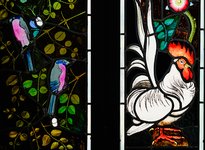
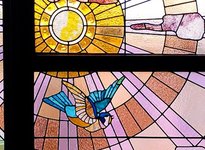
Detail van glasraam in het gemeentehuis van Vorst © Korei Guided Tours

Which animals can you see in the town hall of Forest?

Jean-Baptiste Dewin occupies a special place in Brussels architecture at the turn of the century. He is often associated with Art Nouveau, but his work cannot easily be pigeonholed into a single style. What sets Dewin apart is his consistent and narrative use of animal and plant motifs as an integral part of architecture. For him, decoration is not an afterthought, but a fundamental element of the design.Dewin (1872–1942) worked during a period in which Brussels underwent significant change and architects experimented with new forms, materials, and symbolism. Unlike his contemporaries such as Victor Horta, who abstracted nature into flowing lines and structures, Dewin often opted for recognizable, figurative motifs. Plants, flowers, birds, and other animals appear explicitly in facades, reliefs, mosaics, and ironwork. They give his buildings an almost narrative character and make them both accessible and idiosyncratic.
read article →
Detail glasraam huis Devalck © Korei Guided Tours

What is the difference between art nouveau and art deco?

Art Nouveau is recognizable by its flowing lines, plant motifs, and strong artisanal character, in which architecture, interior design, and decoration form a unified whole. Art Deco, popular since the 1920s, favors clean geometry, symmetry, and luxurious materials, and exudes modernity, progress, and urban elegance.Brussels is one of the best cities in the world to understand the difference between Art Nouveau and Art Deco. Both styles leave their mark on the streetscape, but they differ greatly in atmosphere, form, and ideology. If you look closely, you will see not only beautiful buildings, but also two different moments in Brussels' history.Art Nouveau buildings and guided tours in BrusselsTassel HotelDevalck HouseLouiza districtAlong the Northeast SquaresIn SchaerbeekArt Deco buildings and guided tours in BrusselsVilla EmpainBuuren Museum and GardensPearls along Roosevelt AvenueIn the heart of the cityOn the route of the old harbor
read article →
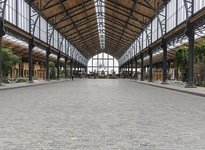
Gare Maritime © A. de Ville de Goyet urban.brussels

Constant changes at the Tour & Taxis site

Brussels is not a city of tabula rasa, but of transformation. This is particularly true of Tour & Taxis, a vast former customs and storage area on the canal. After customs operations ceased in 1993, a third phase began, in which existing buildings were systematically reused. Warehouses, the Royal Warehouse, and the former post office building were given new functions, while contemporary architecture was also added. Within this context, Gare Maritime is not a separate project, but the architectural center of gravity of an area undergoing rapid urban development.Gare Maritime in Brussels is one of the most impressive architectural repurposing projects of recent years. The monumental hall, built in 1902 as a freight station, measures 140 by 280 meters and consists of seven aisles supported by rows of cast-iron columns. The building once formed the logistical heart of the Tour & Taxis site and is now playing that central role again, albeit with a completely different purpose.
read article →
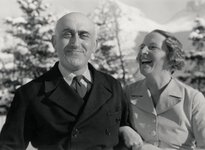
David en Alice van Buuren © Archief Museum en tuinen van Buuren

Who were David and Alice van Buuren?

David and Alice van Buuren lived in the first half of the 20th century in a unique cultural bubble of art, architecture, and international connections. David Michel van Buuren (1886–1955), of Dutch descent, was a successful banker who settled in Brussels in 1909. In 1922, he married Alice Piette (1890–1973) from Antwerp, and together they embarked on a lifelong project: collecting, supporting, and exhibiting art, not only as private individuals, but also as patrons with a deep cultural commitment.Their house, located on Léo Errera Avenue in Uccle, is a textbook example of what is known as a Gesamtkunstwerk — a living environment in which architecture, interior design, and art collection come together to form a single artistic experience. Between 1924 and 1928, the villa was built in the typical Amsterdam School style, while the interior featured an exceptional ensemble of Art Deco designs created by leading Belgian, French, and Dutch interior designers and craftsmen.
read article →
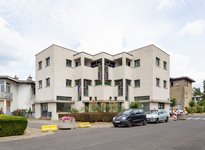
Cité Moderne

What are the differences between modernism and postmodernism?

Modernism and postmodernism differ greatly from each other, and this is clearly visible in Brussels. Modernism, which mainly occurred between 1920 and 1970, is based on the idea that form should follow function. Architecture had to be rational, simple, and efficient, without unnecessary decoration. In Brussels, this led to austere buildings made of concrete, steel, and glass, such as those in the North Quarter with the Manhattan Plan. Old buildings were often demolished to make way for modern office towers. This approach is known as Brusselsization and was later heavily criticized for damaging the historic urban fabric.Postmodernism emerged in the 1970s as a reaction to this austere and often cold modernism. Postmodern architecture rejects the one-sided focus on function and once again makes room for decoration, color, and historical references. In Brussels, this is reflected in renovations and extensions that combine old and new styles, and in a greater focus on the experience of the city and the preservation of heritage. Instead of large-scale demolition, postmodernism often opts for repurposing and respect for the existing environment.
read article →
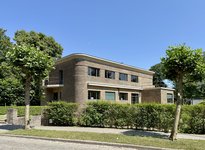
La Nouvelle Maison © Eva Lo

Modernism in Brussels? Absolutely!

The beginning of modernism during the interwar period by XX and XX. In Brussels, XX and XX can be visited from this period. La Nouvelle Maison in Tervuren is a fine example.
read article →